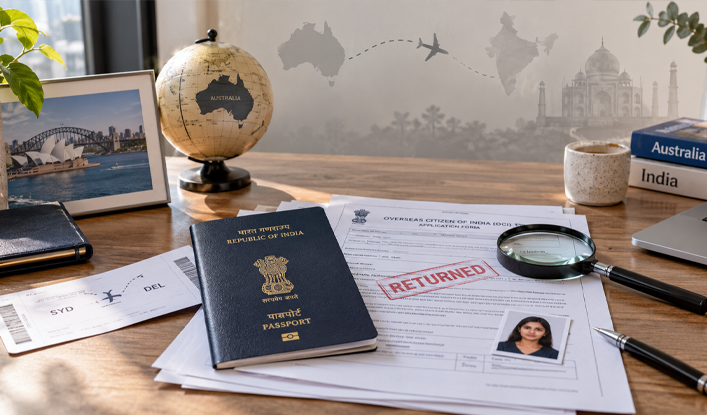
Most OCI applications that come back to an Australian applicant haven’t been refused. They’ve been found deficient. A photo that breaks the specification, a document that doesn’t prove what it’s asked to prove, a signature in the wrong place. India’s OCI Services portal says the mission emails you about the deficiency and you fix it. That’s a delay, not a dead end.
Knowing which of the two you’re looking at changes what you do next. So does knowing which problems can be fixed and which can’t.
At Bharat Suvidha we go through OCI files for people across Australia before they’re lodged, and the same handful of problems come back over and over. Here they are, in the order they bite
Returned” and “rejected” are not the same word
India’s Ministry of Home Affairs runs the OCI Services portal, and its own FAQ describes what happens when something is wrong: “If there is any deficiency in the application/ uploaded documents/ photograph, the Indian Mission/Post/FRRO concerned shall inform the applicant by email.”
You then supply the corrected document and the office uploads it. The application keeps its place.
That’s a deficiency. It’s the common case, and it’s recoverable.
A refusal is different — it means you’ve been assessed as not eligible, and no amount of resubmitting will change that. Read the email carefully before you panic. The two outcomes read similarly to someone who’s been waiting three months, and they call for completely different next moves.
The photo and signature rules are stricter than people expect
The specification is published, precise, and routinely missed.
The OCI Services portal requires the photograph and signature to be JPEG or JPG files of no more than 200 KB. The image must be at least 200 × 200 pixels and no more than 900 × 900. The photo must be square, at least 51 × 51 mm, with the face filling about 80 per cent of the frame.
And this is the one that catches people: the background must be “plain light color background (not white) without the border with front view of the person’s head and shoulders”.
Not white. A studio photo taken against a white wall — the background almost every Australian passport photo booth produces — is the wrong background for this form.
If your application comes back and the email mentions the photograph, start there before you touch anything else.
Your documents have to prove the specific link you’re claiming
The second recurring problem is a document that sounds like proof but isn’t the proof being asked for.
The portal lists what it accepts as evidence of Indian origin or former Indian citizenship:
- a copy of the Indian passport
- a domicile certificate issued by the competent authority
- a nativity certificate from the competent authority
- a parent’s or spouse’s PIO or OCI card, together with documents proving Indian origin
For anyone who gave up Indian citizenship, there’s a harder requirement. The portal asks for a “Cancelled/ Surrendered Indian passport with Surrender Certificate (for those who have surrendered Indian passport in or after 2010).”
That Surrender Certificate trips up a lot of Australian citizens of Indian origin, because plenty of people naturalised here, put the old Indian passport in a drawer, and never formally surrendered it. If that’s you, the surrender is its own separate job and it comes first.
At Bharat Suvidha we complete the form correctly, check it against current requirements, and prepare it for lodgement. In practice that means finding this kind of gap before an Indian mission does. Call (03) 7049 0081 and we’ll go through what you actually hold.
Some bars can’t be fixed with better paperwork
It’s worth being straight about this, because it saves people months.
The OCI Services portal states: “No person, who or either of whose parents or grandparents or great grandparents is or had been a citizen of Pakistan, Bangladesh or such other country as the Central Government may, by notification in the Official Gazette, specify, shall be eligible.”
That’s an eligibility rule, not a documentation rule. No checklist gets around it.
Eligible categories include former Indian citizens, people of Indian origin, and their descendants down to great-grandchildren. Foreign spouses of Indian citizens or OCI cardholders also qualify, where the marriage has been registered and subsisting for at least two years. If you don’t sit inside one of those, the answer doesn’t change with a better application.
Had Your OCI Application Come Back?
The appointment is now part of the application
Since 1 July 2026, VFS Global’s guidance for Australia is that biometric enrolment is mandatory, and “applicants must attend their appointment in person to enrol biometrics at the time of application submission”.
Appointments are mandatory at all six Indian Consular Application Centres: Adelaide, Brisbane, Canberra, Melbourne, Perth and Sydney. They open Monday to Friday, 08:30 to 17:00.
The practical effect is that a gap in your file now surfaces at the counter, with a booked slot burning. It used to surface in an email a fortnight later. Everything above is worth checking before you take the day off work.
Sorting your OCI doesn’t sort your arrival card
Here’s a confusion worth clearing up, because it costs people at the airport rather than at the counter.
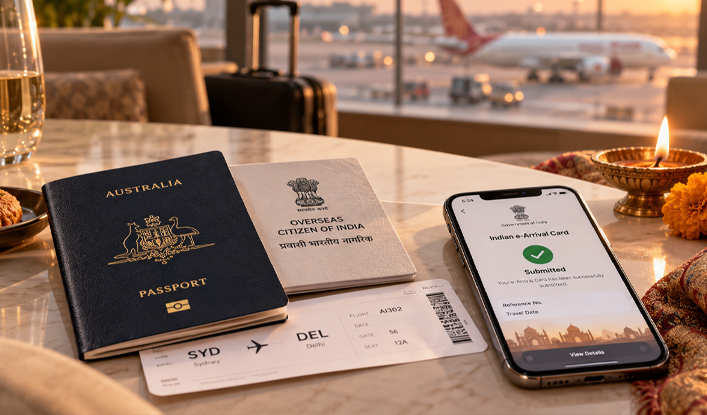
An OCI card and an India e-Arrival Card are different things that arrive at different times. If you’re looking up the India e-Arrival Card from Australia, note that it isn’t an approval, a visa, or a substitute for your OCI. India’s official visa portal describes it in one line: “This is for arrival information, not a visa.”
The same portal says “Foreigners and OCI Card holders can complete and submit the e-Arrival card online within 72 hours before their arrival in India at boi.gov.in or indianvisaonline.gov.in or via official ‘Indian Visa Su-Swagatam’ Mobile App.”
So a valid OCI card does not exempt you from the arrival card, and a submitted arrival card does not rescue an OCI card that’s been returned for correction. Two separate jobs, two separate deadlines. Our guide to the India e-Arrival Card for OCI holders and Australian travellers covers the form itself.
What to check before you book the appointment
| Check | What you’re looking for |
|---|---|
| Photograph | JPEG or JPG, under 200 KB, 200 × 200 to 900 × 900 pixels, square, plain light background that is not white, no border |
| Proof of origin | The specific document the portal names for your category — passport, domicile certificate, nativity certificate, or parent’s or spouse’s card plus origin documents |
| Surrender Certificate | Needed if you surrendered an Indian passport in or after 2010 |
| Eligibility | Your category, and the Pakistan or Bangladesh ancestry bar |
| Appointment | Booked at one of the six centres, with everyone attending in person for biometrics |
Frequently asked questions
Does a returned OCI application mean I have to start again?
Not according to the OCI Services portal. It says the Indian Mission, Post or FRRO informs the applicant of the deficiency by email, and the corrected documents are then submitted for upload. Read the email before assuming the worst.
Why does the OCI photo have to be on a non-white background?
Because that’s the published specification. The portal calls for a “plain light color background (not white) without the border with front view of the person’s head and shoulders”. It’s a common reason a file is sent back.
Do I need an India arrival card for Australians as well as my OCI?
The official Indian visa portal names “Foreigners and OCI Card holders” as the people who complete and submit the e-Arrival Card online, within 72 hours before arriving in India. It describes the card as arrival information, not a visa. Check the portal’s current wording before your own trip.
I’m an Australian citizen who never surrendered my Indian passport. Where do I start?
With the surrender. The OCI portal asks for a cancelled or surrendered Indian passport together with a Surrender Certificate, for anyone who surrendered in or after 2010. That step comes before the OCI application, not alongside it.
Conclusion
You can reach Bharat Suvidha on (03) 7049 0081 or at info@bharatsuvidha.com.au, Monday to Friday, 10AM – 4PM. We work through the checklist with you remotely and post the prepared file out, with free doorstep delivery within Australia.
A returned application feels like a verdict and usually isn’t one. Most of what sends an OCI file back is visible in advance. A photo specification, a certificate nobody mentioned, a category that was never going to fit. Checking those four or five things before you book the appointment is a far cheaper hour than the one you’ll spend at the counter finding out.