One quick heads-up before we dive in: this is general guidance to help you get your bearings, not legal or immigration advice. Citizenship and passport rules can change and every family’s circumstances are a little different, so always confirm the current requirements with the relevant Indian mission, and, if your situation is complex, a registered migration agent, before you lodge anything.
Congratulations on your new arrival! Once the cuddles settle and the visitors slow down, a little pile of paperwork starts tapping you on the shoulder, and if your bub has Indian heritage, sorting out a newborn baby Indian passport (or an OCI card) is one of the first jobs to tick off. The good news is it’s more straightforward than it looks, once you know which path applies to your family. This guide walks you through the whole thing step by step, in plain English, with links to the official Australian and Indian government sources so you can check every detail yourself.
The single most important thing to work out first is your baby’s citizenship, because that decides everything that follows. Let’s start there.
Passport or OCI card? It comes down to your baby's citizenship
Here’s the key point that trips a lot of new parents up: India does not allow dual citizenship. Your child can hold an Indian passport or an Australian one, not both. So the first question isn’t “how do I get the passport,” it’s “is my baby an Australian citizen?”
Under section 12 of the Australian Citizenship Act 2007, a baby born in Australia is an Australian citizen at birth if at least one parent is an Australian citizen or permanent resident at the time of the birth (or if the child goes on to live in Australia for the first 10 years of their life).
That gives you two clear paths:
- Neither parent is an Australian citizen or permanent resident (for example, both of you are Indian citizens on student, skilled or other temporary visas). Your baby is not an Australian citizen at birth; they generally hold the same visa as you, and are eligible for Indian citizenship by descent. This is the Indian passport route (Steps 1–3 below).
- At least one parent is an Australian citizen or permanent resident. Your baby is Australian from birth and also can’t hold an Indian passport. In this case, you apply for an OCI card instead (covered further down).
Sort out which camp you’re in, and the rest of the process falls into place.
The Step-by-Step Process: Simpler Than You Think
Step 1 - Register your baby's birth in Australia
Before anything Indian-related, you’ll need your baby’s Australian birth certificate. In Australia, you register the birth with the Births, Deaths and Marriages registry in your state or territory, and a detail that surprises many parents, the hospital does not do this for you. You have 60 days to register the birth, and you can then order the birth certificate you’ll need for the steps that follow.
This certificate is the foundation document for every step after it, so order it early rather than waiting. Head to your state’s Births, Deaths and Marriages registry, for example, BDM Victoria, BDM NSW, or the equivalent in your state.
Step 2 - Register the birth with the Indian High Commission or Consulate
If your baby is on the Indian passport route, the next step is registering their birth with the Indian mission, and this part is not optional. Under Section 4(1) of India’s Citizenship Act 1955, a child born outside India to an Indian-citizen parent only becomes an Indian citizen once the birth is registered with an Indian mission. Ideally, this is done within the first year. The registration is done online through India’s citizenship portal, and both parents must sign a declaration confirming the child does not hold the passport of any other country.
Once it’s approved, the mission issues a Birth Registration Certificate. This consular document, often exactly what people mean when they search for an Indian birth certificate in Australia, sits alongside (not instead of) your Australian birth certificate, and you’ll need both for the passport application.
Try not to leave this past your baby’s first birthday. Registration is still possible after one year, but it may need extra approval and can take longer, so getting in early saves you a headache.
Step 3 - Apply for your newborn baby's Indian passport
With both birth documents in hand, you can apply for your newborn baby’s Indian passport. You begin the application online on the Government of India’s Passport Seva portal, print the completed form, and submit it with the supporting documents to the official Indian Passport and Visa Application Centre that serves your state.
A few things worth knowing before you start:
- Both parents normally need to sign the parental consent form (Annexure D).
- Only ICAO-compliant photographs are accepted. For a newborn, the photo can be taken with the baby lying on a plain white background; there’s a bit of flexibility for infants.
- An Indian passport for a child under 18 years old is good for five years or until the child turns 18, whichever comes first.
That five-year limit is why renewals come around sooner than you’d expect; more on that below.
Already feeling the paperwork pile up?
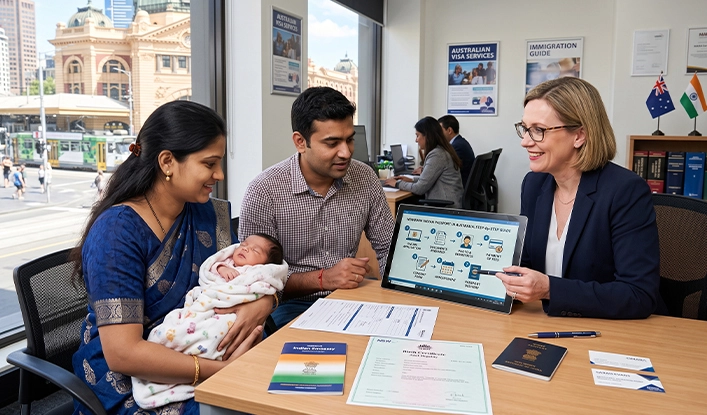
Between the birth certificate, the consular registration and the passport form, it’s a lot to juggle with a newborn on your hip. You don’t have to get it all right on your own.
What if your baby is an Australian citizen? Applying for an OCI card
If at least one parent is an Australian citizen or permanent resident, your baby is Australian from birth and isn’t eligible for an Indian passport. Instead, you apply for an OCI card for your child born in Australia.
An OCI (Overseas Citizen of India) card is a lifelong visa that lets the holder live, work, study and travel in India without applying for a separate visa each trip. It’s a brilliant way to keep your child connected to India, but it’s important to be clear that it is not dual citizenship, and it doesn’t come with voting rights or an Indian passport.
Your child is eligible if both parents are Indian citizens, or if one parent is an Indian citizen or of Indian origin. You apply online through the official OCI portal, then submit your documents to the application centre. You’ll generally need your child’s Australian passport, their Australian birth certificate showing both parents’ names, the parents’ Indian passports or proof of Indian origin, and the parents’ marriage certificate.
Documents you'll usually need
Exact requirements can vary case by case, but for the Indian passport route, most families need:
- Your baby’s full Australian birth certificate (showing both parents)
- The Birth Registration Certificate from the Indian High Commission or Consulate
- Both parents’ Indian passports, plus your current Australian visas
- An ICAO-compliant passport photo of the baby
- The signed parental consent form (Annexure D)
Always check the current checklist on the official application centre’s website before you lodge, as the mission can ask for extra documents depending on your circumstances.
Which Indian mission looks after your application?
India has five missions in Australia, and which one handles your paperwork depends on where you live:
- High Commission of India, Canberra: Australian Capital Territory
- Consulate General of India, Sydney: New South Wales and South Australia
- Consulate General of India, Melbourne: Victoria and Tasmania
- Consulate General of India, Perth: Western Australia and Northern Territory
- Consulate General of India, Brisbane: Queensland
Jurisdictions are set by postcode, so confirm your exact mission on its official website before applying. The day-to-day collection and delivery of applications is handled through the official application centre appointed by the missions.
Renewing or reissuing an Indian passport in Australia
Because a child’s passport only lasts five years (or until they turn 18), Indian passport renewal in Australia is something most NRI families come back to before long. The process mirrors a fresh application: complete the online form on the mission portal, submit the current passport with the supporting documents, and have both parents sign for a minor.
Helpfully, many minor renewal and reissue applications can be submitted by post rather than lodged in person, a relief if you’re not near a capital city. Confirm the current requirements and processing times with the official application centre before you apply.
How Bharat Suvidha takes the stress out of it - in 3 simple steps
New parents have more than enough on their plates without decoding government forms. Bharat Suvidha turns the whole process into three easy steps:
1. Register and share your details
Sign up and send us your information online to get started, no appointments, no queues.

2. Our experts prepare and check everything
Our team completes, reviews and manages your application, heading off the small mistakes that cause delays or rejections.

3. We lodge it and keep you posted
We submit your application correctly and track it the whole way through to delivery, straight to your door.

Important note: Bharat Suvidha operates as an independent, private service provider and is not connected with the Indian Ministry of External Affairs, the Indian Consulates, the High Commission of India, or any government-authorised service centres.
Let someone else chase the forms
You’ve got a newborn to look after, not a stack of government portals to decode. Hand us the details and we’ll take the application from here, start to finish.
Wrapping up
Welcoming a baby is the fun part; the paperwork doesn’t have to be the stressful one. Whether your little one needs a first Indian passport or an OCI card, the path becomes clear once you know your starting point (your baby’s citizenship status) and work through it step by step.
If you’d rather hand the forms to someone who does this every single day, Bharat Suvidha can take it from here. Get in touch to start your application and get back to the bit that matters, your new bub.
Frequently Asked Questions
When should I apply for my baby's Indian passport?
Register the birth with the Indian mission within the first year, then apply for the passport. Applying within the first 12 months keeps everything straightforward and avoids the extra approvals that can come with late birth registration.
Can my baby hold both an Australian and an Indian passport?
No. India doesn’t allow dual citizenship, so a child can hold an Indian passport or an Australian one, but not both. If your baby is an Australian citizen by birth, the OCI card is the way to keep their link to India.
Is my baby eligible for an Indian passport if only one parent is an Indian citizen?
For Indian citizenship by descent, at least one parent must be an Indian citizen at the time of birth, and the child must not hold another country’s passport. If your other parent is an Australian citizen or permanent resident, which makes the baby Australian from birth, you’d apply for an OCI card instead.
How long is a newborn's Indian passport valid?
Five years, or until the child turns 18, whichever comes first.
What happens when my child turns 18?
They’ll need to apply for a fresh adult passport. And if they hold another citizenship alongside their Indian one, under Indian law, a citizen by descent who also holds another nationality generally has to choose between them, typically by renouncing the foreign nationality within six months of turning 18 to keep their Indian citizenship. This area can be nuanced, so confirm the exact position with the mission closer to the time.